Way of Seeing - The Only Way Out is Through
There are emotions that arrive like weather, and there are emotions that become rooms. Sadness can become a room. It can hold us after heartbreak, failure, disappointment, or the collapse of a future we had already begun to inhabit. There is a kind of comfort inside that room. Time seems to stop there. The next decision can wait. The unknown can remain on the other side of the door.
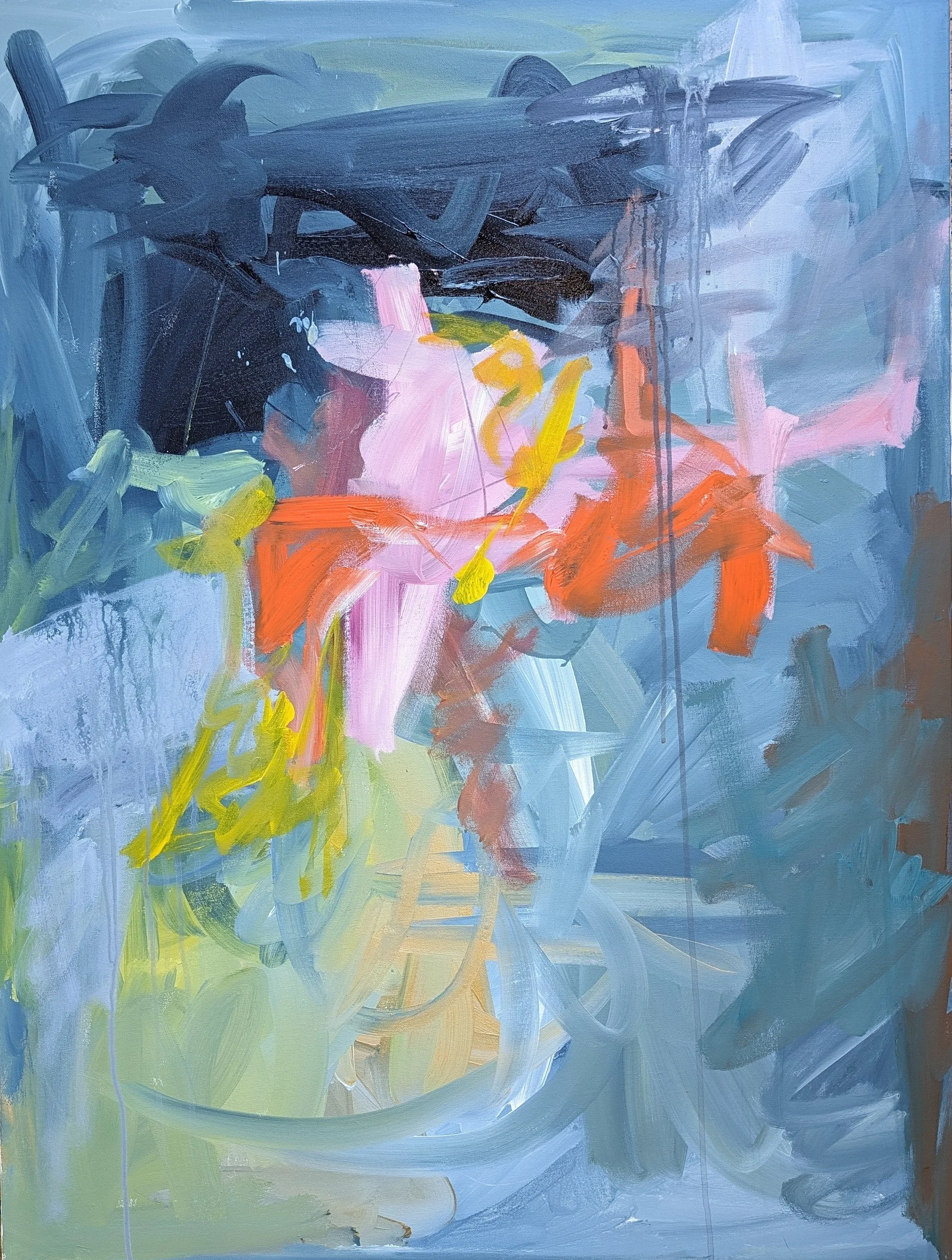
The Only Way Out Is Through began, for me, with the promise of brightness after a long period of heaviness. I first understood it as a light at the end of a tunnel. Looking at it now, I see something more complicated. The darkness ahead may be the tunnel, but it may also be the depth from which a new self is emerging. The painting allows both readings to exist. One viewer may feel the determination to continue. Another may recognize the joy of having already come through.
That openness is part of what abstract painting offers. I can bring my own lived understanding to the work without closing the door behind me. The painting can hold my interpretation and still leave room for another person’s need. The tunnel and the emergence are two ends of the same movement.
The concentrated pink and orange draw the eye toward the centre of the work. One colour might have created a focal point. Together, they weave us into it. They hold warmth, vitality, and an almost bodily sense of return. The translucent yellow trails outward like something already being shed. It feels less like a conscious declaration and more like release happening beneath awareness. The mind may still believe it is standing still, while another part of the self has already begun to move.
This is what I understand differently after living with the painting. Transformation often begins before we decide to transform. Sadness may feel like a pause, but the body, the subconscious, and the deeper intelligence of the self may already be loosening their hold on the future we expected. We are changing while we are still trying to preserve what was.
I have often told my clients, and myself, that any emotion I feel is correct in the moment I am feeling it. That does not make every conclusion accurate, and it does not dictate an action. It means I stop arguing with the existence of the feeling. I let myself believe my own experience long enough to hear what it contains.
The question that follows is simple: now what?
Not, how do I make sure I never feel this again? Not, what should another person have done differently? I ask what I am reacting to specifically, why this moment has touched that place in me, and what the feeling is making available to understand. Sometimes it reveals a boundary that needs to be drawn. Sometimes it reveals an old belief that no longer needs to be defended. Sometimes the only movement required is recognition.
This is where emotional inquiry becomes an act of self sovereignty. I value expertise. We live among people who know more about particular subjects than we do, and there is wisdom in seeking their knowledge. A therapist may help guide a conversation. A spiritual system may offer language. A teacher may help us notice what we have overlooked. There are still questions no expert can answer on our behalf because no one else has lived the precise life that formed our response.
Self sovereignty is knowing which questions belong to that inner conversation. It is knowing that the answer may not be found through more analysis. It may require silence, bodily awareness, contemplation, meditation, prayer, or simply enough space for the inner dialogue to become audible.
My thinking mind can examine a situation from every possible angle. It can spend days considering why someone acted as they did, what they might have meant, and how the story could be interpreted from another position. That intellectual exercise can become endless. The answer that creates clarity is usually much closer: why did I feel this way in response to it?
That question brings the field back into focus. It separates what is mine to change, carry, understand, or release from what remains unknowable. Another person’s motive may never become clear. My own reaction is available to me. I can ask whether it belongs to the present moment, whether it is a habit shaped by an earlier experience, or whether it is showing me a truth I have been reluctant to name.
Recognition also releases the pressure to be right. When I notice that a situation resembles something from the past, I do not have to prove that the pattern is identical. The same kind of experience can awaken different emotions for different reasons. I can ask what is happening specifically today. I may respond differently. I may choose the same response with greater awareness. I may simply note the pattern and allow the recognition itself to be enough.
Lessons repeat in spirals. At twenty, I could understand that idea logically. At fifty-one, I understand it through having returned to familiar questions as a different person. Repetition does not automatically mean failure. We may meet the same shape with greater capacity, better language, and less urgency to force an answer. Intellectual understanding recognizes the lesson. Lived understanding changes the person who meets it.
Anything can become obsession or avoidance, including self-inquiry. This is why it remains a practice rather than a method to master. The measure, for me, is whether the inquiry creates space. When it brings steadiness, clarity, release, or decisiveness, I know I have come closer to what is mine. When it produces more noise, I may need to stop interpreting and allow the emotion to exist without demanding that it explain itself immediately.
The Only Way Out Is Through holds all of this without turning it into instruction. The dark field carries the weight of what cannot yet be seen. The pink and orange offer enough warmth to continue. The yellow records a release already underway. Brightness does not erase the darkness. It makes entering it possible.
Perhaps that is the promise inside the work. We do not need certainty about what waits beyond the tunnel. We need enough contact with ourselves to take the next honest step. The future was always unknown. Sadness did not create that uncertainty, and happiness cannot remove it. What changes is our ability to remain with ourselves as the unknown arrives.
The painting leaves me with a quieter understanding of growth. We do not become sovereign by controlling our emotions or extracting the correct lesson from every experience. We become sovereign by cultivating an inner conversation strong enough to distinguish our own truth from the noise around it. We give the feeling room to speak. We notice what begins to loosen. We choose when a choice is available.
And sometimes, before we have consciously decided to move forward, the light has already begun to return.
The question the painting leaves behind: What changes when we stop measuring growth by whether a lesson returns, and begin noticing who we have become when it does?