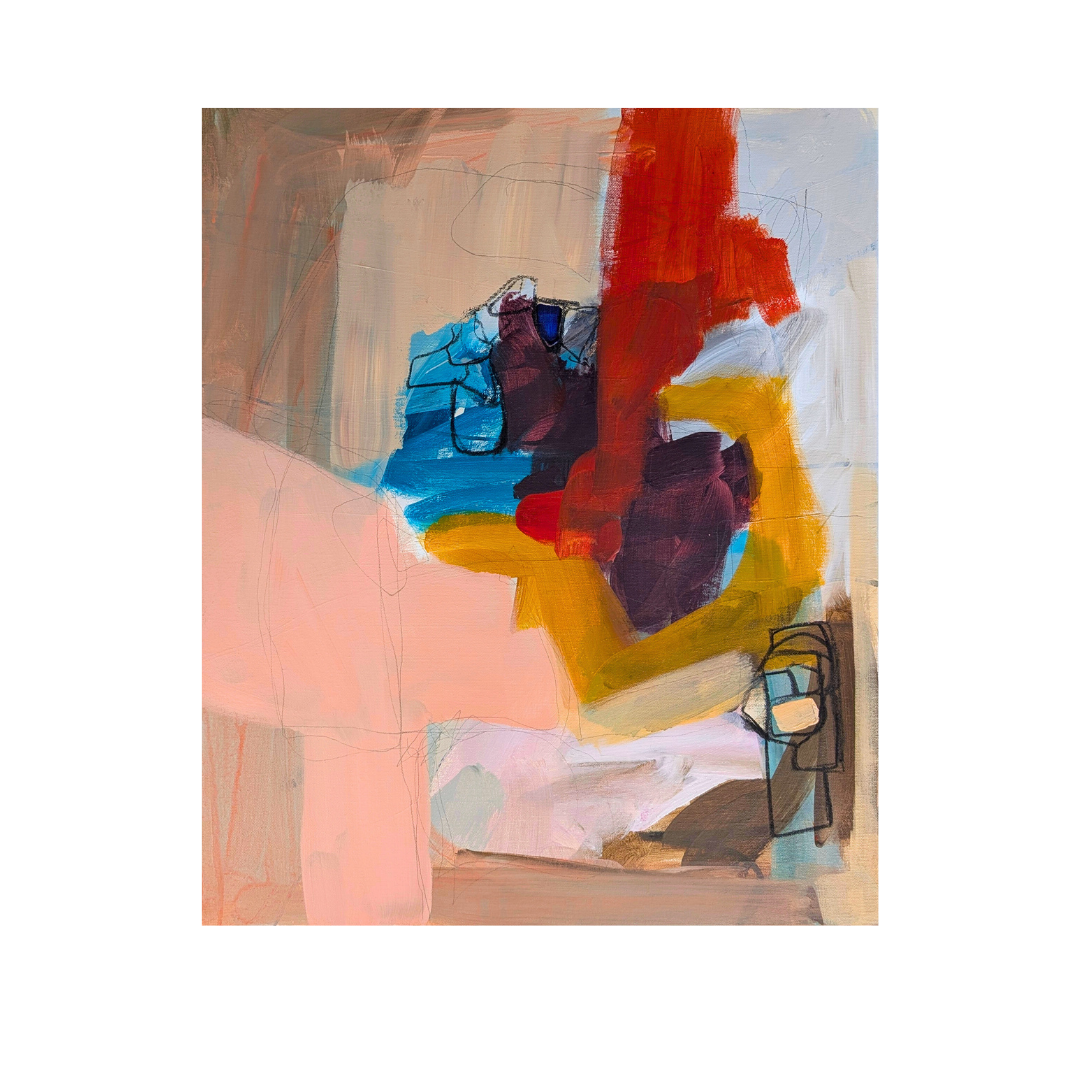
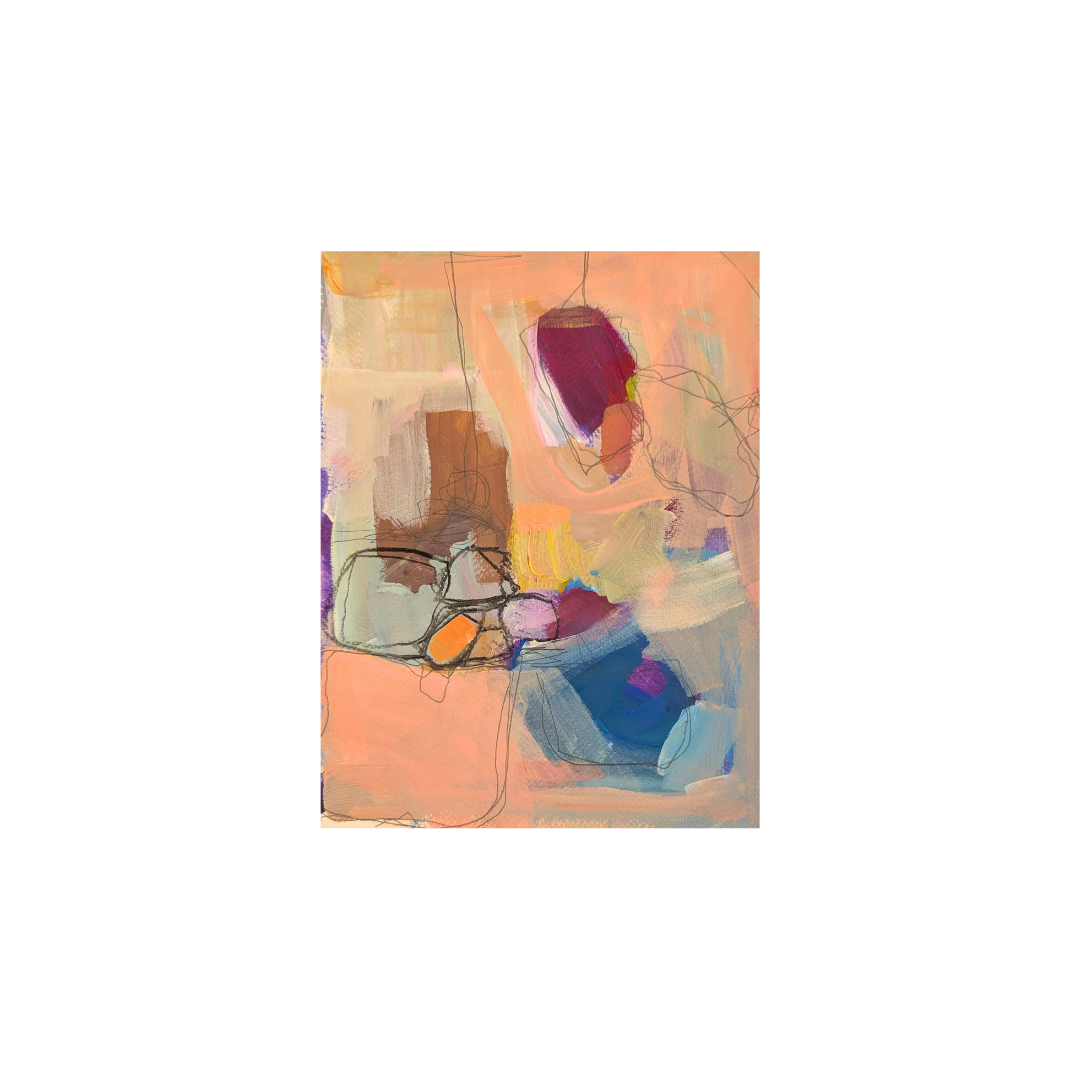
Precipice of Change, 30×40 in, 2025
Precipice of Change opens with a generous peach and blush ground, warm and broadly applied, the lightest palette in any collection Lipsey has made. The surface carries texture throughout, the physical residue of a previous painting beneath this one, an earlier work that did not disappear but became the foundation for what followed. There is a formal poetry in that: a painting about the threshold of change built on top of something that was itself transformed.
Into this warm field the elements arrive with distinct character. A flat cadmium yellow block sits in the upper left, unhurried and separate. A lavender and dusty rose form occupies the upper centre, more architectural than gestural, its edges considered. The crimson and deep red shapes are the most physically loaded areas of the canvas, paint applied with real pressure. A single navy mark lands at the centre, the one cool, dense note in an otherwise warm composition, the weight that keeps the painting from floating. And moving through the mid-field, a looping charcoal line draws through the paint rather than over it, a gesture closer to drawing than painting, loose and continuous, the mark of a hand that was thinking rather than deciding.
Scratch marks pulled through the wet surface reveal the peach ground beneath in thin pale lines throughout. Grey rectangular forms in the lower field sit quietly, more considered than everything above them.
The painting does not depict discomfort. It holds the specific temperature of a moment that is both unsettling and necessary, the feeling you learn, eventually, to recognise as the edge of something good.
From the Emergence collection, 2025.
Inspired by:
"Discomfort is what happens when we are on the precipice of change." — Brianna Wiest
Precipice of Change, 30×40 in, 2025
Precipice of Change opens with a generous peach and blush ground, warm and broadly applied, the lightest palette in any collection Lipsey has made. The surface carries texture throughout, the physical residue of a previous painting beneath this one, an earlier work that did not disappear but became the foundation for what followed. There is a formal poetry in that: a painting about the threshold of change built on top of something that was itself transformed.
Into this warm field the elements arrive with distinct character. A flat cadmium yellow block sits in the upper left, unhurried and separate. A lavender and dusty rose form occupies the upper centre, more architectural than gestural, its edges considered. The crimson and deep red shapes are the most physically loaded areas of the canvas, paint applied with real pressure. A single navy mark lands at the centre, the one cool, dense note in an otherwise warm composition, the weight that keeps the painting from floating. And moving through the mid-field, a looping charcoal line draws through the paint rather than over it, a gesture closer to drawing than painting, loose and continuous, the mark of a hand that was thinking rather than deciding.
Scratch marks pulled through the wet surface reveal the peach ground beneath in thin pale lines throughout. Grey rectangular forms in the lower field sit quietly, more considered than everything above them.
The painting does not depict discomfort. It holds the specific temperature of a moment that is both unsettling and necessary, the feeling you learn, eventually, to recognise as the edge of something good.
From the Emergence collection, 2025.
Inspired by:
"Discomfort is what happens when we are on the precipice of change." — Brianna Wiest

 Image 1 of 6
 Image 2 of 6
 Image 3 of 6
 Image 4 of 6
 Image 5 of 6
 Image 6 of 6